
Intermittent boat problems are the worst kind. Your engine runs beautifully past Naples Bay one weekend, then stumbles the next time you push through Caxambas Pass, and by the time somebody looks at it, everything seems fine again. That is exactly why marine engine diagnostics has changed so much, and why a good mobile mechanic follows a process instead of guessing.
What you’ll need before marine engine diagnostics starts
A fast diagnosis starts before anybody plugs in a scan tool. If your boat is on a lift in Marco Island, tied up in Naples, or kept behind your place in Bonita Springs, the goal is the same: make the visit productive enough to catch the problem without burning half a day on avoidable delays.
Boat details and recent history
Have the basics ready: engine make and model, engine hours, service dates, and anything changed recently. A new battery switch, fresh fuel, a recent impeller service, injector work, or a display install can matter more than it seems. Intermittent faults often show up right after something was disturbed, even if that work was done correctly.
The trick is to think in terms of timeline. If the alarm started two days after a battery replacement, that points the inspection one way. If the issue began right after a fuel-up, that points it another way. A short service history can save a lot of expensive guesswork.
A simple symptom log
“Acts up sometimes” is honest, but it is not very useful. A note on your phone is enough if it includes the day, approximate runtime, RPM, and what the boat was doing when the issue showed up.
Write it like this: “Port engine lost 300 RPM after 25 minutes at 3400 RPM, slight starboard turn, half tank, light chop.” That one sentence is worth far more than a long story without details.
Access, safety, and testing conditions
Make sure the boat can be started, the batteries are charged, and there is room to work safely around the engines. If a sea trial may be needed, conditions matter too. Heavy current, sloppy weather, packed channels, or low fuel can all affect whether the symptom can be recreated cleanly.
That is one reason many owners prefer mobile service in the first place. If your boat stays at the house or marina, getting service where the boat already sits usually beats arranging transport for a problem that may only happen under normal use.
Step 1: Start with the complaint, not the guess
The fastest way to miss an intermittent fault is to decide what it is before checking what it actually does. A bad ground can look like a sensor problem. Fuel starvation can look like ignition trouble. A flaky module can feel like an engine issue even when the engine itself is fine.
Define the symptom in plain English
Start with plain descriptions: hard start, random shutdown, power loss, surging, alarm with no shutdown, smoke on acceleration, one engine trailing the other. That language is better than tossing around part names too early.
Jargon tends to make people jump ahead. Plain English keeps the focus on what can be observed and tested.
Separate “always” from “only when”
This matters more than most people think. “Always hard to start” is a different path from “hard to start only first thing in the morning.” “Loses power every run at 3200 RPM” is different from “did it twice in rough water.”
Timing is often the whole trick. If a fault appears only after twenty minutes, the problem may be heat-related. If it happens only in turns, fuel pickup or a moving electrical connection starts to look more likely.
Confirm the operating context
Load, fuel level, trim, outside temperature, sea state, and whether the issue happens tied to the dock or only underway all shape the diagnosis. A boat that idles perfectly at the slip but stumbles during acceleration is giving a very different clue than a boat that misbehaves even in neutral.
That context is what turns a complaint into a test plan.
Step 2: Do a fast dockside inspection first
Before deeper diagnostics begin, the obvious stuff gets checked. Honestly, this step solves more “mystery” problems than most owners expect.
Check batteries, grounds, and voltage stability
Low or unstable voltage can create all kinds of nonsense: random alarms, false sensor readings, intermittent no-starts, and control glitches. Marine electrical systems live in heat, vibration, and salt, which is not exactly a gentle environment. In fact, saltwater and vibration are major reasons marine equipment develops reliability problems that look random at first.
Battery terminals should be tight. Grounds should be clean. Charging voltage should stay stable instead of wandering around. A boat can still crank and yet have enough voltage drop to confuse electronics once the engine warms up.
Inspect fuel, water separators, and visible leaks
Fuel issues love to hide at the dock. A partially restricted filter may let an engine idle all day, then fall on its face under load. Water in the separator, damp fittings, air leaks on the suction side, and contaminated fuel are classic causes of intermittent power complaints.
Fuel is such a common culprit that one technical review found fuel system faults account for a large share of marine diesel engine failures. Even on recreational boats, the logic holds up. If power loss shows up under demand, fuel delivery goes high on the list very quickly.
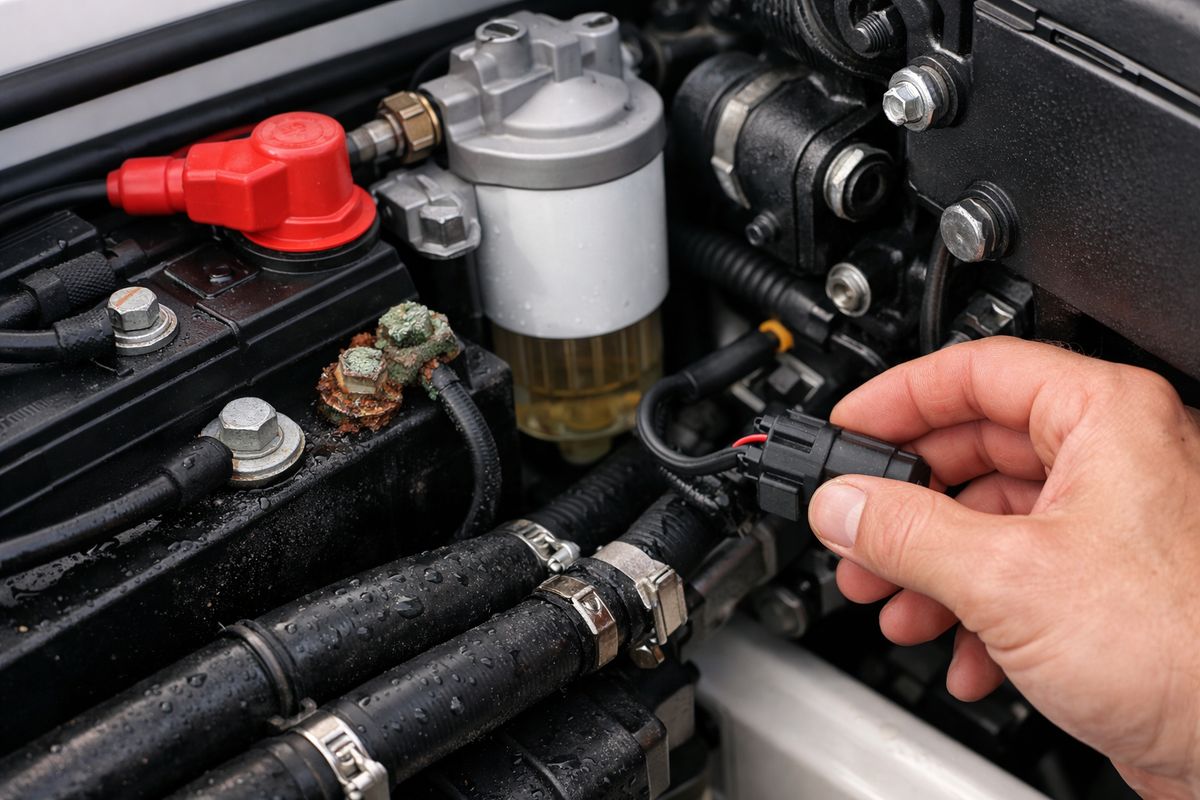
Look for heat, corrosion, and loose connections
A connector can look acceptable and still fail once it gets hot and starts vibrating. Corrosion under insulation, slightly loose harness plugs, browned terminals, and cooked-looking components matter.
Here’s the thing: intermittent faults often leave physical clues before they leave obvious fault codes. That is why a quick visual pass still matters even with modern scan tools.
Step 3: Scan the engine and onboard systems for stored clues
After the basics are covered, the electronics get checked. Modern boats store more history than most owners realize.
Read active, inactive, and pending fault codes
Active codes mean the problem is happening now. Inactive codes show what happened earlier. Pending codes sit in the middle, not severe enough yet to become a hard failure, but not nothing either.
That distinction is useful because intermittent issues often leave breadcrumbs rather than a giant flashing answer.
Review freeze-frame or snapshot data
Some systems store a little “photo” of engine conditions at the moment a fault set. That can include RPM, coolant temp, oil pressure, throttle position, or voltage. One captured snapshot can settle an argument fast.
If the code set during a voltage dip at idle, that points one way. If it set at 3650 RPM with rising temperature after a long run, that points another.
Check related modules beyond the engine
Controls, displays, network modules, battery management, and digital throttles can all create engine-like symptoms. Sometimes the engine is innocent and the problem lives in the data path around it.
Modern systems are built for real-time monitoring, predictive maintenance, and tighter controls, which is helpful when everything works and a little maddening when one module starts misbehaving. The good news is that a proper scan can often see beyond the engine ECU itself.
Step 4: Compare fault data with what your boat is actually doing
Codes help, but they are not a verdict. A fault code points in a direction. It does not hand over the whole answer.
Match codes to the complaint timeline
The first question is simple: do the stored events line up with when your symptom started? If a code last occurred three weeks ago and your issue began yesterday, that old code may be background noise.
If the timestamp, runtime, and operating conditions line up, now you have something useful.
Watch for misleading or secondary codes
A single low-voltage event can throw a cluster of unrelated-looking faults. One failing sensor can trigger alarms in systems that are only reacting to bad input. Chasing each code separately is how time and money disappear.
The catch is that the first code listed is not always the first thing that went wrong.
Use service history to narrow the field
Recent work matters because changed conditions matter. A battery replacement, electronics install, fresh fuel sender, impeller job, or injector service can all create clues. Not because recent work is automatically the problem, but because diagnosis always starts with what changed.
If you want a better sense of what should be fixable on site versus what usually turns into a bigger repair, it helps to know which jobs are realistic at the dock before approving a string of maybe-parts.
Step 5: Monitor live data at the dock
Stored history is helpful. Live data is where things get real.
Check idle RPM, charging voltage, and sensor readings
Once the engine is running, key values should look steady. Idle RPM should not hunt around for no reason. Charging voltage should stay in a normal range. Coolant temperature, oil pressure, and available sensor values should make sense for that engine at that moment.
A wandering value is often more revealing than a hard failure. If the engine stumbles and one sensor suddenly drops out, that is a lead worth following.
Compare port and starboard engines when applicable
Twin-engine boats come with a built-in comparison tool. If one side is healthy and the other is acting up, matching data side by side makes abnormal behavior much easier to spot.
One engine may show normal warm-up temperature and stable charging, while the other drifts or spikes. That contrast saves time.
Look for patterns during warm-up
Some faults wait until heat soak sets in. Others appear when thermostats open, resistance changes, or engine-room temperatures rise. That is why a dockside run sometimes needs patience.
An issue that never appears cold but shows up after fifteen minutes is not being difficult. It is being specific.
Step 6: Reproduce the issue under real operating conditions
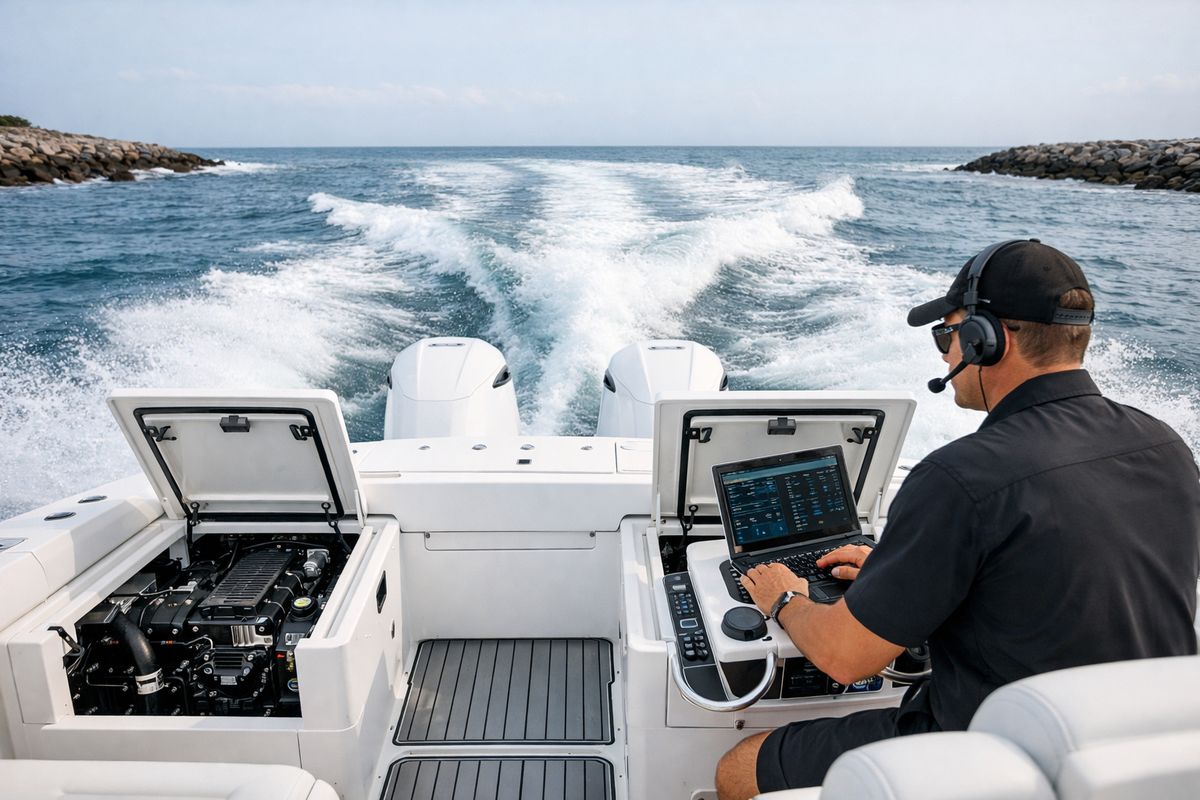
For true intermittent problems, the sea trial is often where the answer finally shows up. Dock talk becomes evidence once the boat is doing the thing that causes the complaint.
Run the boat through the exact conditions that trigger the fault
The mechanic tries to recreate your exact scenario: same RPM band, same hole shot, same hard turn, same runtime, same kind of load. If the issue happens only after twenty minutes on plane leaving Caxambas Pass, that detail is gold.
Marine surveys and professional troubleshooting increasingly rely on sea-trial logging because engines often behave differently under real load than they do tied to the dock. That is especially true for fuel delivery, cooling performance, and vibration-related electrical faults.
Log engine data during the run
A proper trial is not just somebody standing there listening. RPM, temperatures, pressures, voltage, fault activity, and other available parameters should be watched and, when possible, recorded.
That matters because intermittent faults are slippery. In the moment, you notice the stumble. Ten minutes later, the exact sequence is already fuzzy. Logged data gives you something concrete to compare.
Note environmental and handling factors
Trim angle, sea state, tank level, crosswind, wave impact, and hard turns can all matter. Rough water can change prop load and drivetrain behavior, and load instability in rough seas can influence how propulsion systems respond.
Sometimes the engine is not failing in a random way at all. It is reacting to a very specific combination of load, motion, and runtime.
Step 7: Test the likely systems one by one
Once the symptom is reproduced or strongly narrowed, the process becomes more targeted. This is where disciplined troubleshooting beats parts swapping every time.
Fuel delivery checks
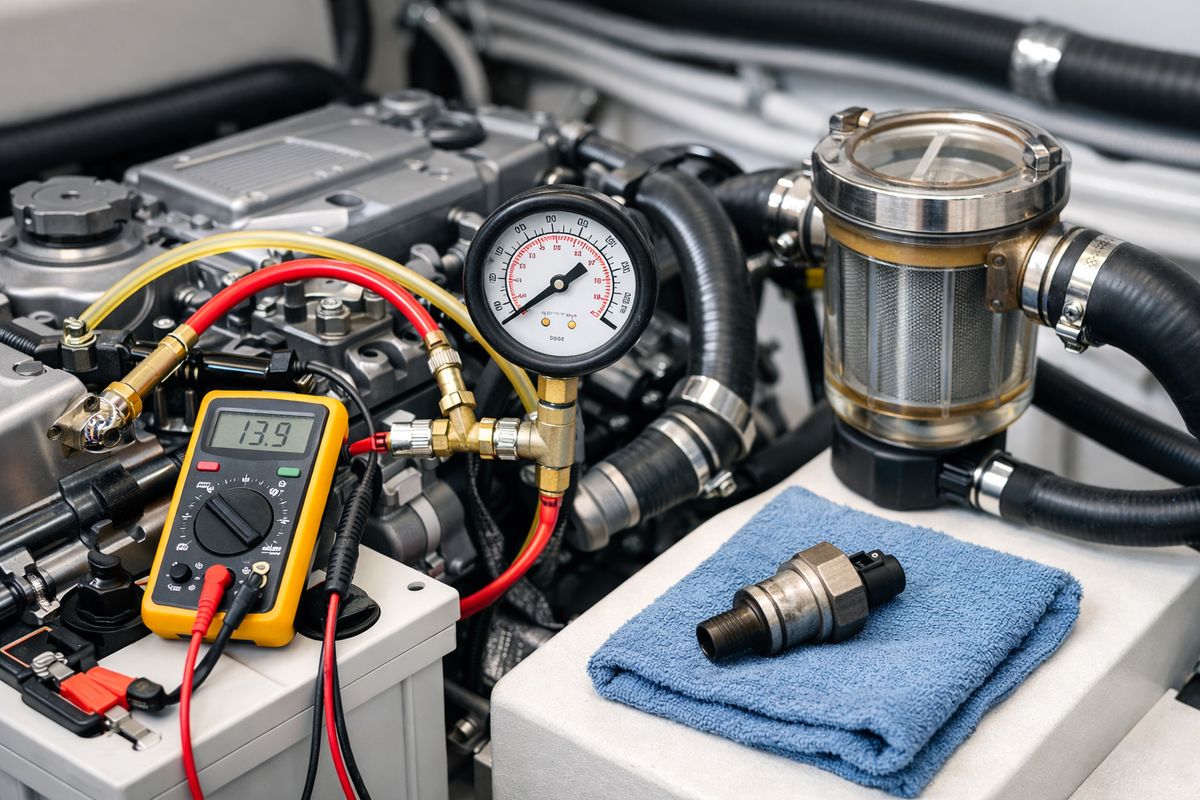
Fuel pressure gets checked under the right conditions. Filters get inspected. Pumps, venting, pickups, separator condition, and possible air leaks all move into focus. A restriction upstream may not show itself until the engine demands more fuel.
Many “random cut-outs” are really fuel starvation wearing a disguise.
Electrical and charging checks
Alternator output, battery condition, voltage drop, harness integrity, grounds, and connector quality all need to hold up under load, not just at rest. A system can have enough power to start and still become unstable after warm-up.
This is one reason keeping up with routine service intervals matters so much. Intermittent electrical problems love neglected terminals, aging batteries, and connections that have been slowly getting worse for months.
Sensor and control checks
Some sensors drift only when hot. Throttle and shift position sensors can lose calibration or develop dead spots. Network communication can drop in and out with vibration. A bad sensor is like a front door lock that only jams when you’re late. It behaves just well enough to waste your time.
The point here is proof. A suspected sensor fault should show bad data, bad behavior, or a repeatable failure pattern, not just suspicion.
Cooling and exhaust checks
Partial blockages, weak raw-water flow, sticky thermostats, restricted coolers, and exhaust temperature issues can all create intermittent derate, alarm, or power loss. Heat-related faults often show up after a long run, then disappear once everything cools off again.
That pattern is common enough that cooling checks should never be skipped just because the engine temperature looked okay for five minutes at the dock.
Step 8: Use supporting evidence when the problem still won’t show itself
Some issues refuse to act up during a short visit. That does not mean nothing is wrong. It just means the next layer of evidence matters more.
Review historical engine data and alarm logs
Longer-term logs can reveal repeating overheat records, low-pressure events, voltage dips, or recurring sensor faults that did not happen today. Modern diagnostics is moving toward condition-driven maintenance for exactly this reason. The history often tells the story even when the engine behaves during the appointment.
That is especially useful for owners who use the boat on weekends and do not want every odd symptom to turn into a full-day chase.
Consider oil analysis and fluid condition
If there is concern about internal wear, coolant intrusion, fuel dilution, or contamination, fluid condition can reveal what your eyes cannot. Oil analysis is one of the few ways to catch hidden trouble before it becomes loud and expensive.
It is not needed for every intermittent fault, but when the evidence points inside the engine, it is a smart move.
Document findings for follow-up testing
If the fault still refuses to repeat, the best next step may be a watch list. That can include exact RPM to note, runtime to record, which gauges to photograph, and which warning lights or alarms matter most.
If you ever need urgent help later, having that information makes a faster breakdown response far more useful than a vague “it quit again.”
Step 9: Confirm the root cause before replacing parts
This is where good diagnosis separates itself from expensive trial and error.
Verify the fault with a repeat test
A suspected cause should be tested and, when possible, confirmed by repeating the original condition. If replacing or correcting one item changes the symptom in a clear, repeatable way, confidence goes up fast.
One good test is worth more than three hopeful guesses.
Distinguish root cause from symptom
A low-voltage event may trigger sensor codes. A clogged pickup may trigger an overheat alarm. A communication fault may make the display look like the engine is failing. The first alarm is not always the first failure.
That sounds obvious, but it is where a lot of money gets wasted.
Build a repair plan around urgency and use
Once the cause is narrowed or confirmed, repairs should be ranked. Some problems need immediate attention. Some can wait until parts arrive. Some are monitor-for-now items with clear limits.
For a boat in the 25 to 55 foot range, this matters. Your goal is not a theoretical perfect machine. Your goal is a boat that starts, runs, and gets you through a weekend on the water without drama.
Step 10: Decide on the fastest path to a reliable fix
After diagnosis, the question becomes practical: what can be handled now, what needs scheduling, and what should be watched?
Handle dockside repairs when possible
Filters, battery issues, bad connectors, some sensors, relay problems, minor fuel corrections, and basic electrical repairs can often be handled on site if access is good and the diagnosis is clear.
That is the sweet spot for mobile service. A lot of owners are surprised by how much can be repaired dockside once the real cause is identified.
Schedule deeper repairs when access or parts are the limit
Some jobs need parts ordering, longer labor, haul-out, or shop support. If confirmation points to a bigger cooling issue, internal engine concern, or major system replacement, forcing a same-day fix is usually the wrong move.
Fast is good. Rushed and half-proven is not.
Set up preventive monitoring
Once you know what to watch, intermittent issues become less mysterious. You may be asked to monitor specific gauges, note exact conditions, or use better onboard monitoring to catch a repeat event cleanly.
That one change can turn “it happens once in a while” into actionable evidence the next time out.
Troubleshooting: Common intermittent boat issues and what usually causes them
Some complaints show up over and over. The symptom does not confirm the cause, but it does point the testing in a useful direction.
Random shutdown after running fine for a while
Think heat, fuel delivery, vent restriction, vapor issues, or voltage drop after warm-up. Time-to-failure is the best clue. If shutdown consistently happens after a certain runtime, temperature and demand need close attention.
Alarm with no obvious performance change
This often points to senders, pending faults, communication glitches, or low voltage rather than a major mechanical failure. The engine may be running fine while the information system is not.
Loss of power only at higher RPM
Restricted fuel flow, air restriction, cooling limits, boost-related faults on some setups, or even load and prop issues can all show up here. If the engine only complains when asked for more, the limiting system usually appears in the data.
Hard start that disappears later in the day
Battery condition, fuel prime loss, cold-start sensor input, and moisture-related electrical issues are common suspects. Morning-only problems are usually not random at all. The first start conditions are simply different.
One engine runs differently than the other
On twin-engine boats, a noticeable difference in response, temperature, RPM, or sound is useful. Matching engines should behave closely. When one side does not, comparison testing speeds up the diagnosis a lot.
What you should expect after a proper diagnosis
A proper visit should leave you with more than “maybe try this.” You should come away with a documented symptom, the most likely cause, supporting evidence, and a clear repair path.
A written summary of findings
Useful notes include codes found, test conditions, live data observations, what changed during testing, and what still needs confirmation. Good documentation pays off later if the issue comes back or another visit is needed.
A confidence-based repair recommendation
Not every finding carries the same certainty. Some repairs are confirmed. Some are the most likely next step. Some are maintenance items worth doing because access is open and risk is obvious. Clear confidence levels help you approve the right work without feeling like you are funding a fishing expedition.
Your next move
Before the next service call, do one simple thing: write down the exact RPM, runtime, and condition when the problem happens again. That single note can cut through a surprising amount of mystery.
Frequently Asked Questions
How long does marine engine diagnostics usually take?
A basic dockside diagnostic visit can be fairly quick if the fault is obvious. Intermittent problems often take longer because the engine may need to warm up, run under load, or go through a sea trial before the issue shows itself.
Can intermittent boat problems be diagnosed if the engine is running fine right now?
Yes, sometimes. Stored fault history, pending codes, live data, alarm logs, and physical inspection can all reveal clues even when the engine behaves during the appointment. If nothing shows up, the next step is usually documenting the exact conditions that trigger the problem.
Are fault codes enough to tell you what part to replace?
No. Fault codes point to a system or condition, not always the failed part. A voltage drop, wiring issue, or bad sensor can trigger other codes that make the real cause look like something else.
Why does my boat only lose power at higher RPM?
Because some faults only appear when demand rises. Fuel restrictions, cooling limits, air restrictions, weak pumps, or sensor problems may stay hidden at idle and only show up once the engine is asked to work harder.
Is a sea trial really necessary for intermittent issues?
Often, yes. Many intermittent faults appear only under load, after warm-up, during turns, or at a certain RPM band. A dockside check can miss all of that.
What should you write down when the problem happens?
Note the engine side, RPM, runtime, speed, fuel level, sea conditions, turns or acceleration, alarms, and whether the issue cleared on its own. A short phone note made in the moment is usually enough.